17 Small Patio Ideas to Maximize Your Outdoor Space
Seventeen practical ideas for a smaller patio, with a clear purpose, comfortable seating, useful shade, and manageable planting.
Make the patio useful before making it full
The best small patio ideas give a limited area a clear purpose. A patio does not have to hold a dining set, lounge furniture, a grill, planters, and a storage bench to count as an outdoor living space. A comfortable place to sit with an open route back to the house can be a more satisfying result than a crowded arrangement that promises every activity.
Begin with a simple plan showing the door, drains, steps, fixed equipment, and the routes people use. Measure the usable surface and observe the sun during the hours you expect to sit outside. Consider where furniture will go in bad weather. These practical questions make it easier to choose improvements that belong to the space rather than merely fit inside its boundaries.
Use the ideas below selectively. A rental courtyard, an exposed paved corner, and a sheltered patio beside a family kitchen have different priorities. Keep required exits and access clear, seek permission for changes where necessary, and get appropriate advice before attaching structures or adding significant loads. The aim is a space you can enjoy and maintain comfortably.
Start with a clear layout
1. Choose one main activity
Decide whether the patio is primarily for meals, conversation, or a quiet pause. Give that activity the best position and allow other uses only when space genuinely remains. A two-chair reading corner can feel complete. Trying to force a second activity into the same footprint often makes both less convenient and creates furniture that must be moved constantly.
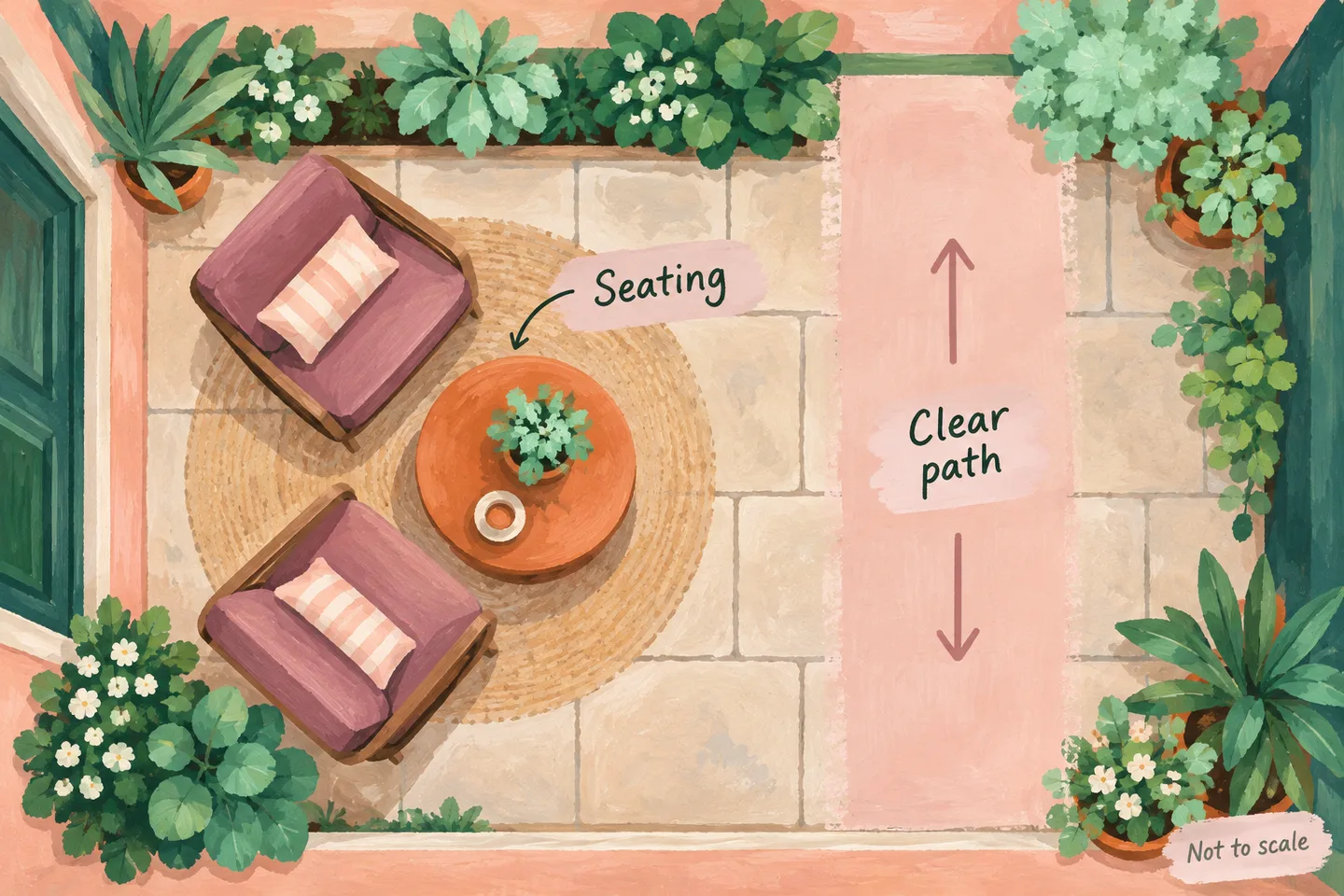
2. Keep a visible route through
Mark the route from the house to the garden, bins, or storage. Test it with chairs occupied, not just pushed neatly under a table. Avoid placing pots where their foliage will eventually intrude. A clear route improves the sense of space because movement feels natural rather than negotiated around a series of obstacles.
3. Test furniture with full-size outlines
Use cardboard or removable surface-safe markers to represent furniture footprints. Include arms, chair pullback, and moving parts. Walk the plan carrying the things you normally take outside. A compact table may be workable while a larger set is not, even when both appear to fit on a scaled drawing. Test before committing to the purchase.
4. Place the main seat deliberately
Try the chair in more than one orientation. Facing the garden, looking toward the house, or sitting at an angle can produce quite different experiences. Notice glare, wind, and the view from indoors. The most useful position may not be the one that lines up perfectly with the edge of the paving.
Let a few pieces do the work
5. Use a small table for a specific purpose
A drink table and a dining table solve different problems. Choose the surface you actually need rather than assuming every patio requires meal seating. Check stability, reach, and the room needed for knees or chair movement. A table that can only be used after rearranging the patio is probably serving the drawing better than the household.
6. Consider movable furniture honestly
Lightweight or folding pieces can support flexible use when they are easy to move and have a realistic storage location. They are less helpful if folded furniture remains propped against the only clear wall. Test weight and mechanisms before buying, and follow the maker's safety guidance. Flexibility works when the routine is manageable, not merely possible.
7. Avoid deep furniture by default
Generous lounge seating can consume a small patio quickly. Compare seat depth and the space needed to stand up with a chair you already find comfortable. An upright outdoor chair may serve conversation and reading well without requiring the footprint of a large lounge. Comfort depends on fit and support, not on size alone.
8. Let one finish connect the pieces
A shared metal tone, timber color, or textile can make different pieces feel related. You do not need an entire matching set. Choose a limited palette that works with the house and paving, then repeat it with restraint. This makes the patio easier to adapt when an individual item needs replacing or your use of the space changes.
Make the edges useful without closing them in
9. Group containers instead of scattering them
A concentrated planted corner can feel more deliberate than small pots distributed around every edge. Leave access for watering and check where runoff goes. Select plants for the actual light rather than the desired photograph. The arrangement should support the seating area without turning the walking route into a path around individual containers.
10. Think vertically with appropriate permission
A suitable freestanding plant support or an approved wall-mounted feature can add interest without using the entire floor. Confirm stability, exposure, and fixing requirements before installation. Do not attach items to a wall, fence, railing, or shared structure on assumption alone. A lightweight-looking object can still impose loads or affect a surface.
11. Screen the view that matters
You may only need privacy beside one chair, rather than a tall barrier around the whole patio. Identify the actual sightline from the seat and consider a suitable screen or planting position. Account for wind, mature growth, maintenance, and local restrictions. A focused solution can preserve more light and openness than enclosing every boundary.
12. Keep some boundary visible
Not every edge needs planting, storage, or decoration. A stretch of clear wall can give the eye somewhere to rest and make the patio easier to clean. Use empty space as part of the composition. The goal is not to hide the limits of the patio completely, but to make those limits feel orderly and useful.
Improve comfort where you spend time
13. Observe shade at the right hour
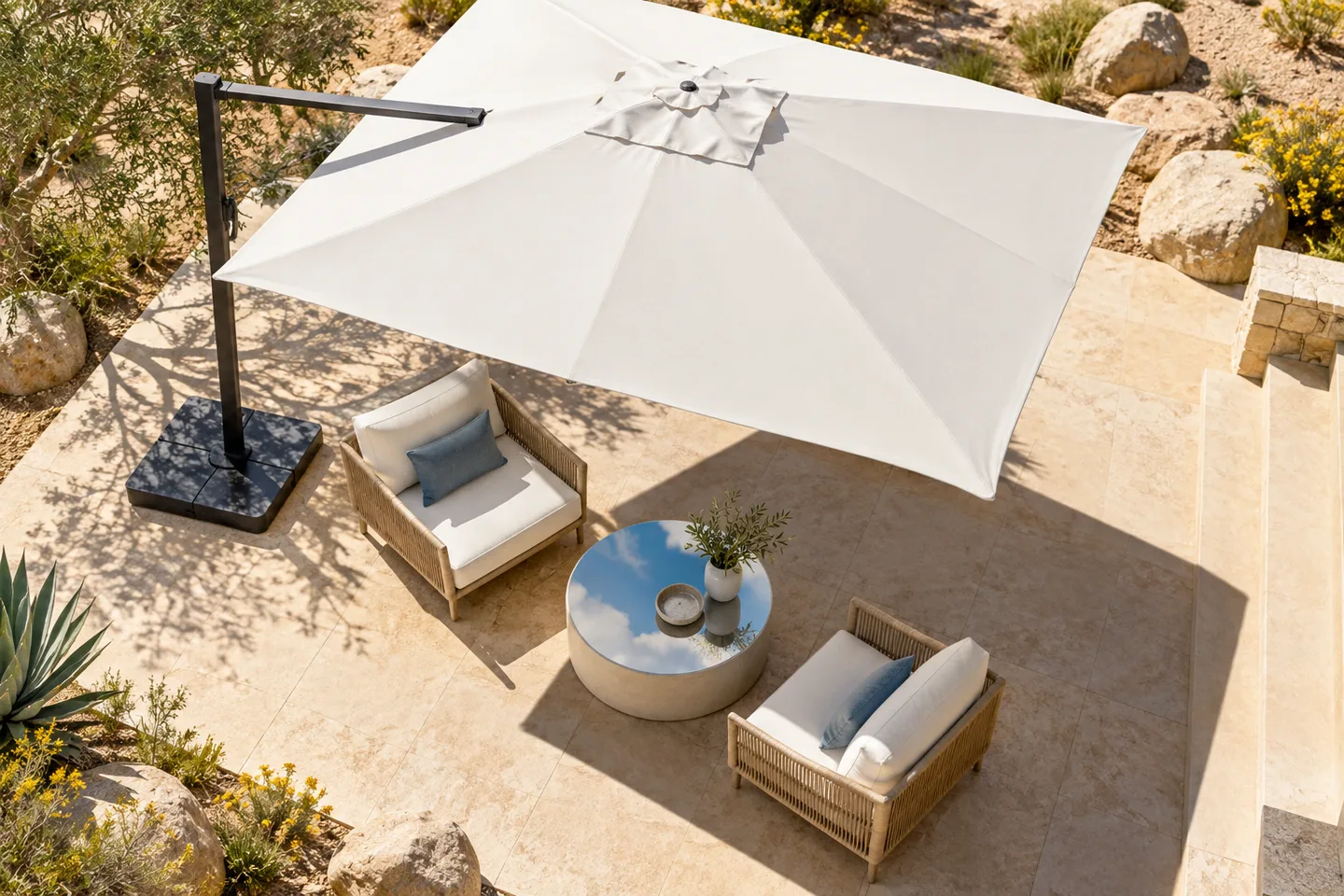
The sunny patch at breakfast may become an uncomfortable seating area later in the day. Observe the patio during the hours it will be used before choosing an umbrella or other shade system. Follow product requirements for bases, anchoring, and wind use. A shade plan is successful when its shadow reaches the occupied seats at the relevant time.
14. Plan for a breeze without blocking circulation
Notice where wind makes sitting unpleasant or moves loose accessories. A suitable screen may help, but its height, openings, and installation need consideration. Do not improvise an unsupported solid barrier. Start with the seating orientation and the location of lightweight objects before deciding that the patio needs a permanent new feature.
15. Use textiles you can manage
A cushion can improve a chair, but several soft accessories create a drying and storage routine. Check the fabric instructions and decide where items go during prolonged rain. Avoid using an outdoor rug to cover a drainage or surface problem. Choose textiles as part of the practical arrangement, not as a requirement for a finished-looking space.
16. Light the useful moments
Think about the route back to the house and the surface used for a drink or evening conversation. Use equipment suitable for the location and keep cables away from walking routes. Fixed electrical changes need appropriate professional attention. Soft local illumination can be useful without making the whole yard as bright as an interior room.
17. End with a maintenance plan
Leave space to sweep, reach drains, inspect furniture, and water containers. If every task requires dismantling the arrangement, simplify it. Choose materials with care requirements you can sustain. The patio will usually feel more welcoming when it is easy to keep usable than when it contains one more decorative feature that makes upkeep awkward.
Try a two-person patio scenario
Imagine an eight-by-ten-foot paved area beside a back door. These dimensions are an example, not a prescribed minimum. One possible plan uses two upright chairs and a small reachable table, with planting grouped beyond the main walking route. A larger dining set might occupy most of the same surface before any chair is pulled out.
Test the chosen layout during an ordinary evening. Bring out a drink, open the door fully, and walk to the garden while another person remains seated. Check the view from inside and the route in low light. The test reveals whether the patio supports daily use rather than merely presenting a tidy collection of furniture.
Keep one part of the patio adaptable
Leave a modest area uncommitted until the main use is working. It can provide temporary room for a visitor, a garden task, or simply easier movement around the seats. Do not assume that flexible floor space is wasted space. On a small patio, the ability to change an ordinary activity without dismantling the arrangement can be one of the most valuable features.
Questions about a smaller patio
Should a small patio use only small furniture?
No. One comfortable, correctly scaled chair can be better than several tiny pieces. Prioritize the number of objects and the occupied arrangement. Keep the main route clear and select dimensions that suit your body and the intended activity.
Does the whole patio need shade?
Not always. Shade over the place you actually sit may be sufficient. Observe changing conditions before choosing a product, and account for its support requirements and wind guidance. Avoid sacrificing the main route to fit an umbrella base.
What should I change first?
Choose the most frequent frustration: crowded seating, poor placement, unsuitable planting, or missing shade. Test a rearrangement before shopping. Continue with cozy seating, patio shade options, and container gardening when the main purpose is clear.