Backyard Privacy Ideas That Are Practical and Attractive
Identify the sightline that needs screening, then compare focused panels, planting, curtains, and furniture changes without enclosing everything.
Solve the sightline, not an imagined boundary
The most effective backyard privacy ideas address a specific view from a place you actually use. A chair overlooked from one neighboring window may need a focused screen, not a tall enclosure around the entire yard. Start by sitting in the space and identifying what feels exposed. The relevant sightline is often different at seated height than it is when standing at the property edge.
Look outward and inward. Consider the view you want to keep, the daylight reaching the patio, and the way a new screen will appear from the house. Privacy is one part of a comfortable outdoor space, alongside airflow, access, planting conditions, and maintenance. A solution that blocks the unwanted view but makes the patio dark and cramped may be too broad for the problem.
Before installing fences, posts, attachments, or substantial planting, confirm boundaries, permissions, local restrictions, and any homeowner or tenancy conditions. These are property-specific questions. A decorative screen is still an installation that must be stable and suitable for wind and use. Do not assume that a lightweight appearance removes the need for appropriate support.
Map the view from the seat
Place the main chair where it will normally be used. Ask another household member to stand at relevant viewing positions where access is permitted, or observe the geometry from your own property. Avoid intruding on neighboring space. Mark the narrowest area where screening could interrupt the unwanted view while preserving the outlook you value.
Try a temporary visual outline using a safely held board or another suitable mock-up, without leaving an unstable barrier in place. Check the proposed height from both sides of the seating area. This test can show that a screen beside a chair works better than a higher barrier farther away. It also helps identify whether the screen would block useful sun or a route.
Record whether the privacy concern occurs year-round or only during a particular season or activity. A deciduous plant may not provide the winter effect you expect. A fabric curtain may be useful when actively managed but unsuitable as a permanent unattended barrier. A clear description of the need helps narrow the options before aesthetics take over.
Option one: change the arrangement
Moving or turning the seating is the lowest-commitment experiment. A chair may feel less exposed when its back is near a suitable wall or planting edge. The conversation group may work better at another angle. Test the view from indoors as well, because the most private orientation can change the relationship between the patio and the house.
Keep circulation clear while experimenting. Moving furniture out of a sightline should not obstruct the exit or access to equipment. If the new arrangement solves most of the concern, live with it before building anything. The remaining problem may be small enough for a focused planting group or a modest screen rather than an entirely new boundary treatment.
Option two: use a screen near the seating
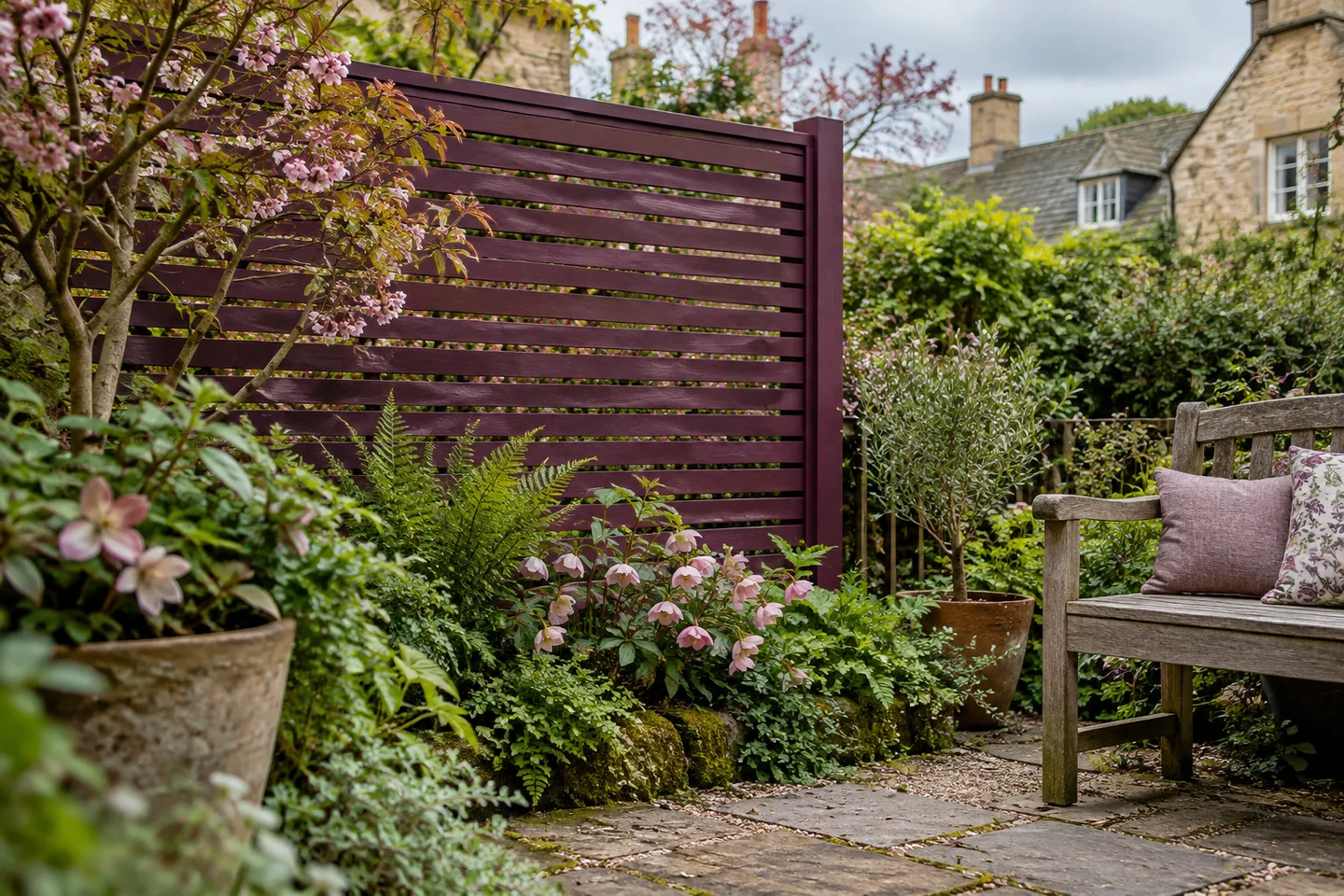
A well-positioned screen can create an edge to an outdoor room without enclosing the whole yard. Slats or openings may preserve some light and visual connection, but the design still needs proper support and a suitable installation. Ask how the proposed material behaves in wind and weather, and how it will be cleaned or repaired.
Check the screen from the direction of the unwanted view. A slatted design can appear private from one angle and surprisingly open from another. The orientation and spacing matter, not just the overall height. Avoid ordering from a front-facing product photograph without considering the oblique views around your patio.
Freestanding products also need scrutiny. Read their intended-use and anchoring instructions. A broad panel can catch wind even when it is easy to carry. Do not improvise a base or lean a panel against furniture as a substitute for installation. If the support requirements do not suit the site, choose another option rather than forcing the product to work.
Option three: develop a planted layer
Plants can provide a softer form of screening while contributing to the garden. Their usefulness depends on mature size, growth habit, seasonal foliage, and the light and root space available. Discuss significant screening plants with a reliable local nursery or landscape professional, particularly near buildings, utilities, paving, and boundaries.
A narrow planting strip may not support the mature shrub shown in a reference photograph. Allow for growth and access for care rather than placing plants at their nursery spacing indefinitely. Avoid assuming that rapid growth is always an advantage; it can bring pruning and management that do not fit the available time.
Container planting can offer flexibility, but heavy pots and mature plants introduce weight and stability questions. Drainage and irrigation need planning, and a container may not provide the same overwintering conditions as garden soil. Use the container planning guide to think through those responsibilities before treating pots as movable pieces of fencing.
Option four: consider curtains selectively
Outdoor curtains can create temporary enclosure when the supporting structure and product are suitable. They require an operating routine: opening, securing, drying, and storing as instructed. Loose fabric can move in wind and interfere with furniture or routes. Decide who will manage it and under what conditions it will be put away.
Confirm that the fixing points and structure are appropriate for the intended use. Do not assume an existing pergola or porch beam can accept arbitrary attachments. Consider the fabric's actual care requirements and exposure rating. A curtain that remains damp against a surface or repeatedly blows into the seating may create more inconvenience than privacy.
Use fabric to define a particular corner rather than automatically covering every open side. This can retain the feeling of being outdoors while offering privacy when needed. Test how the closed curtain affects light, breeze, and the route to the house. The space should still feel usable when the privacy feature is active.
Balance privacy with the rest of the patio
| If the main concern is | Consider first | Review carefully |
|---|---|---|
| One direct view toward a chair | Orientation or a focused screen | The view around the screen's edges |
| A broad lower-level view | A suitable boundary or planting plan | Restrictions, light and maintenance |
| Occasional exposure during meals | A manageable temporary solution | Wind, storage and occupied circulation |
| Seasonal loss of foliage | A year-round landscape strategy | Mature size and winter appearance |
Do not confuse visual screening with sound insulation. A decorative panel or planting group may change the feeling of the space without substantially reducing noise. If sound is the main problem, describe that separately and seek appropriate advice. Buying a visual screen on the assumption it will solve every form of exposure can lead to disappointment.
Consider neighboring light and views without treating the project as a confrontation. A well-explained plan can be easier to coordinate when work affects a shared edge. Keep any agreement and permission clear, and verify the actual boundary rather than relying on where an old fence happens to stand. The article cannot establish property rights or installation approval.
Questions about backyard screening
How tall should a privacy screen be?
Start with the sightline you want to interrupt, then check what is allowed and structurally appropriate. Taller is not automatically better. A screen closer to the seat may solve a focused view at a different height than a boundary screen, while leaving more light and openness elsewhere.
Are plants easier than a built screen?
They involve a different commitment rather than no commitment. Plant choice, growing conditions, mature dimensions, watering, and pruning all matter. A planted solution may take time to develop and may vary seasonally. Choose it because it suits the site and care routine, not simply because it avoids construction.
Can privacy and a small patio work together?
Yes, when the solution is focused. Define the specific seat or activity that needs screening and keep the main route open. Use small patio planning, cozy seating, and shade selection to coordinate privacy with the other parts of the space.
Plan the view when the screen is not in use
Temporary privacy solutions have an off-duty condition as well as an active one. Curtains need somewhere to gather without blocking movement, movable panels need appropriate secure storage, and seasonal planting changes its outline. Look at those conditions before deciding that a product is flexible. A panel stored against the only usable wall can take more everyday space than the privacy arrangement itself.
For permanent screening, ask how it will be maintained from both sides where access is permitted. Finishes, fasteners, and adjacent planting may need attention later. Avoid placing a screen so tightly against another feature that routine care becomes impossible. A little planning for the less visible side of the installation can prevent an attractive new boundary from becoming an awkward maintenance corner.
Start with the least extensive workable solution
Test orientation, map the sightline, and compare one or two suitable options. Keep a record of the view you are trying to improve so you can assess the result after installation or planting. Privacy is successful when you feel comfortable using the yard, without creating a barrier that becomes the dominant problem in the space.