Patio Shade Ideas for Hot and Sunny Backyards
Compare umbrellas, pergolas, awnings, planting, and other shade approaches against the shadow your seating actually needs.
Follow the shadow, not the product photograph
Patio shade ideas work when they shade the place you occupy at the time you use it. An umbrella can look perfectly centered over a table in the morning and leave the chairs exposed later in the day. A pergola may give an attractive pattern of light without providing the level of cover you expected. Start with the sun and the seating rather than selecting a structure first.
Observe the patio in the morning, around midday, and later in the afternoon. Note where the household actually sits, where reflected light comes from, and which route must remain clear. Revisit the pattern as seasons change. Your goal is not necessarily to cover every square foot; it may be to make one everyday sitting area more usable.
Shade is a comfort measure, not a guarantee that heat or ultraviolet exposure is eliminated. Follow relevant health guidance for hot conditions and do not rely on a canopy alone. For structures, anchoring, and attachments, use product instructions and qualified advice. Wind, loads, permissions, and building conditions are part of the choice from the beginning.
Start with the simplest change available
Before buying equipment, test whether moving the seating helps. A chair placed nearer an existing covered edge or oriented differently may become more comfortable during the time you normally use it. This approach does not solve every patio, but it can reveal the exact area that still needs shade and avoid sizing a product around an unused section of paving.
Look at the house's existing shade and any established trees without assuming those conditions are permanent. Foliage changes seasonally, trees grow, and nearby structures may affect the pattern. Keep maintenance and access in mind. Do not position furniture where roof runoff, falling debris, or other site conditions create a new problem in exchange for shade.
Write a short brief: which seats need coverage, during what hours, and whether the shade needs to move. Add the surface available for supports and a plan for storing or securing equipment. This brief is especially valuable when comparing products whose catalog dimensions do not describe their actual shadow on your patio.
Compare the main shade options
| Option | Useful when | Questions to resolve |
|---|---|---|
| Freestanding umbrella | A seating area needs adjustable cover | Required base, operating room, wind instructions |
| Table umbrella | The table and product are designed together | Compatible opening, support, occupied chair clearance |
| Retractable awning | Shade is wanted near a suitable building edge | Structure, installation, controls, weather limitations |
| Pergola | A defined outdoor area suits a permanent structure | Permissions, foundations, actual shade pattern |
| Shade sail | A properly engineered tensioned installation is feasible | Anchors, loads, geometry, drainage and wind |
| Established planting | A longer-term landscape approach fits the site | Species, growth, roots, seasonal cover and maintenance |
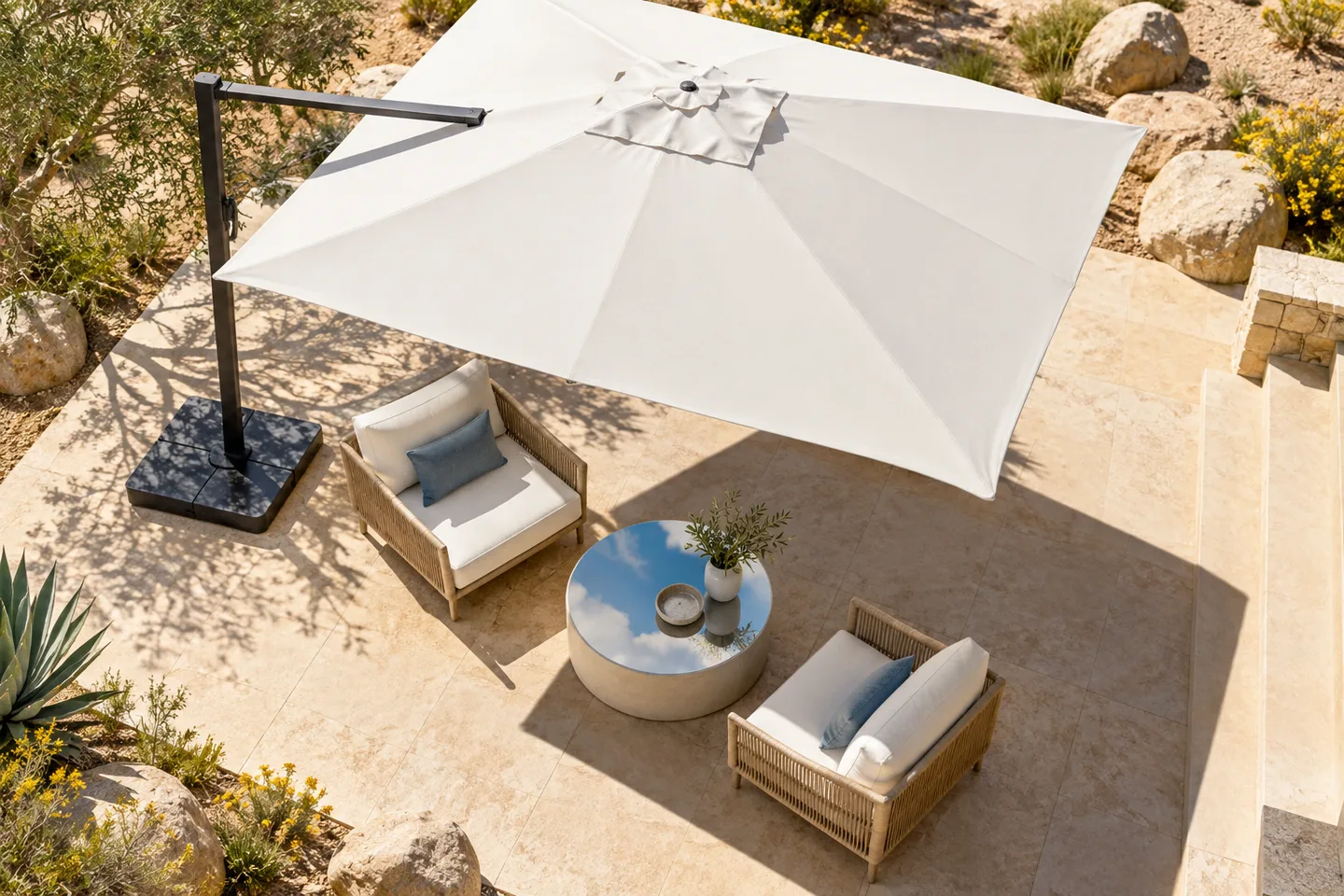
An umbrella is often flexible, but its base is part of the usable footprint. A cantilever design can move the support away from the center of the table while requiring substantial space elsewhere. Include the base, moving arm, and opening action in your plan. Follow the exact product guidance rather than substituting an improvised support because it looks heavy enough.
A pergola should be assessed for the shade it actually provides, not the impression of enclosure in a photograph. Open rafters allow changing areas of sun. Additional fabric or panels can change the loads and weather behavior of the structure. Confirm compatibility and appropriate design before adding cover to an existing frame.
A shade sail is a tensioned system, not simply a piece of fabric tied wherever a fixing is available. The building, posts, hardware, geometry, and local conditions need an appropriate design. Do not attach it casually to a fence, railing, tree, or fascia. Use a qualified installer or designer when the project requires structural assessment.
Check the occupied area and the supports together
Lay out the table and chairs first, then mark where the shade equipment needs to stand. Test the arrangement with people seated and moving through it. An umbrella base that blocks the route back to the house can undermine the patio even when the shadow is useful. Consider whether the equipment can be operated without leaning over furniture awkwardly.
For adjustable shade, understand what movement the product permits. Tilting or rotating a canopy may change which chairs are covered, but it can also alter clearance and exposure. Follow instructions and avoid modifying a mechanism to achieve a position it was not designed to hold. A product should support the required use without improvised workarounds.
Think about the view from indoors. A canopy near a window may affect daylight or the outlook, while a support may interrupt a frequently used sightline. These are design tradeoffs rather than automatic reasons to reject the product. Review them deliberately so the shade works for both the patio and the rooms beside it.
Plan for wind, rain, and days you are away
Read the maker's limits and instructions before purchase, including when the product should be closed, removed, or stored. Do not assume the term outdoor means unattended in every condition. A practical shade plan includes who will operate it and what happens when weather changes while nobody is using the patio.
Water handling matters for covered systems. A fabric or panel installation can direct runoff toward a doorway or seating area if the geometry is wrong. Permanent or attached products may require building and drainage review. Avoid adding an ad hoc sheet to an existing frame simply because it appears to provide immediate shade.
Keep the maintenance routine realistic. Can the canopy be cleaned as instructed? Is there accessible storage for removable parts? Can the operating mechanism be reached safely? A product that demands more handling than the household will perform may not be the right match, even if its coverage looks excellent on the day it is installed.
Use planting as a considered long-term layer
Trees and climbing plants can contribute shade, but they are not instant replacements for a properly specified canopy. Plant choice involves climate, mature size, roots, maintenance, and the suitability of any supporting structure. Discuss significant planting near buildings, paving, utilities, or boundaries with an appropriate local professional.
Containers may soften a sunny corner but do not necessarily shade seated people effectively. Choose them for their own growing conditions and avoid overcrowding the patio to create a lush effect. If a planted support is proposed, consider its weight and stability when mature and wet, as well as its appearance at installation.
Use a combination only when each part has a clear job. For example, established planting may provide background cover while a suitable umbrella serves the main seats at a particular hour. The arrangement should be easy to understand and maintain. More layers are not automatically more effective if their supports crowd the usable floor.
Questions to ask before buying shade
What size umbrella should I choose?
Start with the area occupied by the intended seats, then examine the product's actual coverage and support requirements. Consider the sun angle at the relevant hour. The canopy's listed diameter is useful, but it does not tell you the complete shadow pattern or how the base fits the patio.
Is a pergola enough for a very sunny patio?
It may or may not provide the cover you want, depending on its orientation, spacing, and design. Observe or model the expected shadow before committing. If additional cover is needed, specify it as part of the structure rather than attaching unreviewed materials afterward.
Can I install a shade sail myself?
Only undertake work that matches the product instructions, your skills, and the assessed supports. Tensioned systems can impose significant loads. Where anchors, foundations, or structural suitability are uncertain, use a qualified professional and obtain any required approvals rather than guessing from the fabric size.
Compare a proposed shadow with the actual seating plan
Take a simple photograph or sketch at the hour the patio feels least comfortable. Mark the occupied chairs, the table, and the walking route. Use the proposed product dimensions and the installer's explanation to understand where its cover is expected to fall. Do not confuse an overhead plan with a shadow diagram: the sun's angle affects the result, so the relationship needs to be considered at the relevant time.
For a hypothetical patio used mainly in late afternoon, a centered midday shadow may be less valuable than cover reaching the western side of the seating group later. The best solution could involve moving the chairs as well as selecting equipment. This example is a planning question, not a fixed orientation rule for every property.
If a professional proposes an attached system, ask to review the support and water-handling plan alongside the expected shade. Keep the written operating guidance with the household's outdoor-care information. A clear explanation of how the product should be used is part of its value, especially when weather changes or someone else needs to operate it.
Make the shade serve the seating
Review the small patio planning guide, comfortable seating ideas, and privacy options together. Solve the hour and location that matter most first. A smaller, correctly planned shaded corner can be more useful than a broad installation that misses the seats when you want to use them.